European Jewry
European Jewry ×
5 titles
 Forthcoming
Nonfiction
Yiddish Scholarship Comes to America
The YIVO Institute at 100
Price: $36.99
 Forthcoming
Nonfiction
1873
The Rothschilds, the First Great Depression, and the Making of the Modern World
From the author of the Pulitzer Prize–winning Lords of Finance, a magnificent and timely reckoning with the first truly global financial calamity and the famous banking family at the center of the whirlwind
Over the course of the 1850s and 1860s, during the first era of globalization, the world experienced an unprecedented economic boom. Fueling this expansion was an explosion in the global bond market, at the hub of which stood one family—the Rothschilds, arguably the wealthiest banking family in history. While the giant sums of capital provided through the bond market built the railroads, the century’s most transformative investments, the money raised also unleashed a frenzy of speculation, massive overinvestment, and wasteful borrowing by governments.
With excessive euphoria leading to disappointed expectations, in the early 1870s the bubble burst. Stock markets from Vienna to New York crashed, and dozens of railroads and many governments defaulted. Financial officials responded by blundering into a precipitous remaking of the global currency system—exacerbating the ensuing economic collapse and setting the stage for decades of a punitive deflation that sparked waves of anti-globalist populism. As Liaquat Ahamed shows us in this enthralling history, the crisis of 1873 was, among other things, a death blow to Reconstruction in the United States and the proximate cause of the Ottoman Empire’s slow death spiral. Ironically, though the Rothschilds had presciently kept a low profile during the bubble, when the deluge came, they were viciously scapegoated as part of a wider hatred directed at “Jewish finance,” a strain of antisemitism that would come to full evil flower during the twentieth century.
1873 is a bird’s-eye reckoning with the full dimension of the crisis, from its buildup to its long aftermath. The Rothschilds and a cast of other witnesses give us the human perspective. And we have a brilliant financial historian’s grasp of the larger forces at play, resulting in a global narrative with thrilling explanatory power.
Price: $32.00

Nonfiction
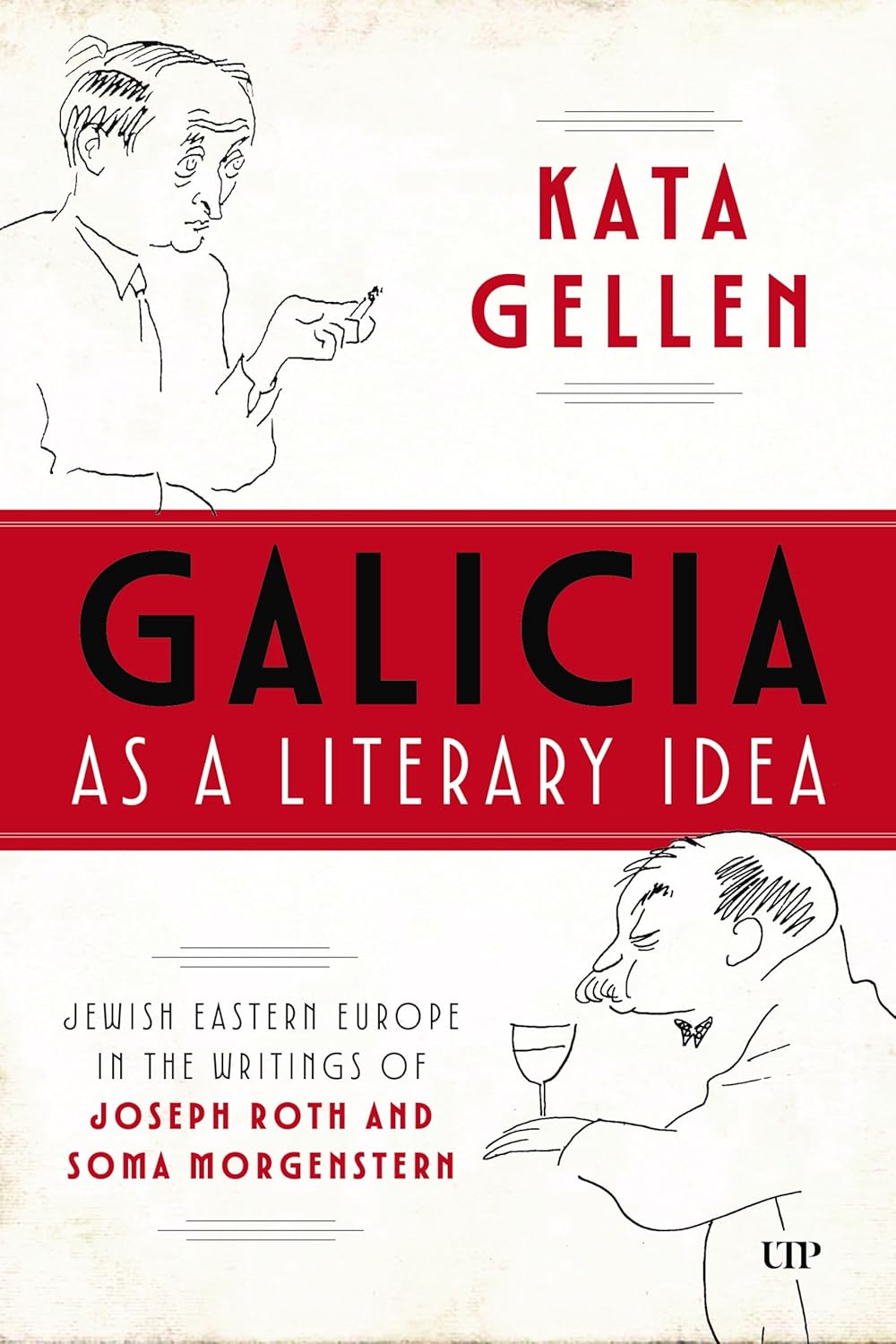
Galicia as a Literary Idea
Jewish Eastern Europe in the Writings of Joseph Roth and Soma Morgenstern
In the decades following the dissolution of Austria-Hungary, the former province of Galicia inspired the literary imagination of two German-language natives of this region, Joseph Roth and Soma Morgenstern. Galicia as a Literary Idea explores what their engagement with Galicia means for modern Jewish culture, history, and memory.
For Roth and Morgenstern, Galicia encapsulates the rich interplay between contemporary developments – including urbanization, secularization, embourgeoisement, political self-determination, and new technologies – and traditional Jewish life in Eastern European villages and shtetls, characterized by tight-knit families and communities, religious observance and ritual, Yiddish language and culture, and Hasidic belief systems. Despite the tensions between these elements, this book presents them as a complex network rather than a battle between old and new, east and west, or tradition and modernity. German and Jewish studies scholar Kata Gellen also traces the shifting attachments of Galician Jews to German, a language that symbolized emancipation, culture, empire, and, ultimately, disillusionment and persecution.
Through original readings of well-known and neglected works by Roth and Morgenstern, Gellen shows how the literary idea of Galicia is shaped by continuous struggle and emergent hope, whether as earthly possibility or redemptive promise. This book thereby uncovers the complex relationship between center and periphery in Jewish modernity and reanimates a dimension of modern Jewish literary history that has been obscured by the dark shadow of the Holocaust.
Price: $95.00
Nonfiction
Galicia as a Literary Idea
Jewish Eastern Europe in the Writings of Joseph Roth and Soma Morgenstern
In the decades following the dissolution of Austria-Hungary, the former province of Galicia inspired the literary imagination of two German-language natives of this region, Joseph Roth and Soma Morgenstern. Galicia as a Literary Idea explores what their engagement with Galicia means for modern Jewish culture, history, and memory.
For Roth and Morgenstern, Galicia encapsulates the rich interplay between contemporary developments – including urbanization, secularization, embourgeoisement, political self-determination, and new technologies – and traditional Jewish life in Eastern European villages and shtetls, characterized by tight-knit families and communities, religious observance and ritual, Yiddish language and culture, and Hasidic belief systems. Despite the tensions between these elements, this book presents them as a complex network rather than a battle between old and new, east and west, or tradition and modernity. German and Jewish studies scholar Kata Gellen also traces the shifting attachments of Galician Jews to German, a language that symbolized emancipation, culture, empire, and, ultimately, disillusionment and persecution.
Through original readings of well-known and neglected works by Roth and Morgenstern, Gellen shows how the literary idea of Galicia is shaped by continuous struggle and emergent hope, whether as earthly possibility or redemptive promise. This book thereby uncovers the complex relationship between center and periphery in Jewish modernity and reanimates a dimension of modern Jewish literary history that has been obscured by the dark shadow of the Holocaust.
Price: $95.00

Nonfiction
Forest as Commemoration in Jewish-Israeli Memory Culture
A Study in Environmental Memory
Situated within the broadly understood subfield of environmental memory studies, this book explores Israeli forests as spaces of commemoration. It investigates their significance in the Jewish‑Israeli memory culture over the last century, as well as their role as a recurrent form of environmental memorial, understood as a commemoration that uses the organic as both the symbolic and the building substance. In doing so, it reveals the roles that the natural environment plays in memory practices: as a carrier of symbolic meanings, and also as an acting, more‑than‑human element of memorial spaces.
Employing the perspective of environmental hermeneutics, the analysis is grounded in the realities of the Israeli–Palestinian conflict and reflects on the intricate intersection of ideological, political, socio‑economic, personal, and institutional dimensions of local tree planting. Simultaneously, it draws from instances of arboreal commemorations found in other geographical and cultural contexts, situating the practice of memorial forests within the wider framework of environmental memory and its associated social practices. In this way, it offers instructive insights for other cases of arboreal remembrance, highlighting both the potential benefits and risks linked to environmental memorials.
Utilising an interdisciplinary approach, this fascinating and groundbreaking volume will engage scholars and researchers from a wide range of disciplines, including Memory Studies, Cultural Geography, Israel Studies, and Environmental Humanities.
Price: $61.99